The 12 biggest conversion killers for your hotel website
The second half of the year is just around the corner—your goal: more conversions for your hotel.
Let's go!
New, stylish hotel website -> check (maybe with
hellohotel.io?).
Integrate a booking engine -> check.
Put together attractive package deals -> check.
All that's missing now is the guests to make the investment worthwhile.
To avoid possible negative surprises, we have compiled the biggest conversion killers for your hotel website. You can use this to check whether any have crept into your website.
1. long page load time
Good usability of a website means that visitors stay longer on the website. This also increases the likelihood that they will make a booking.
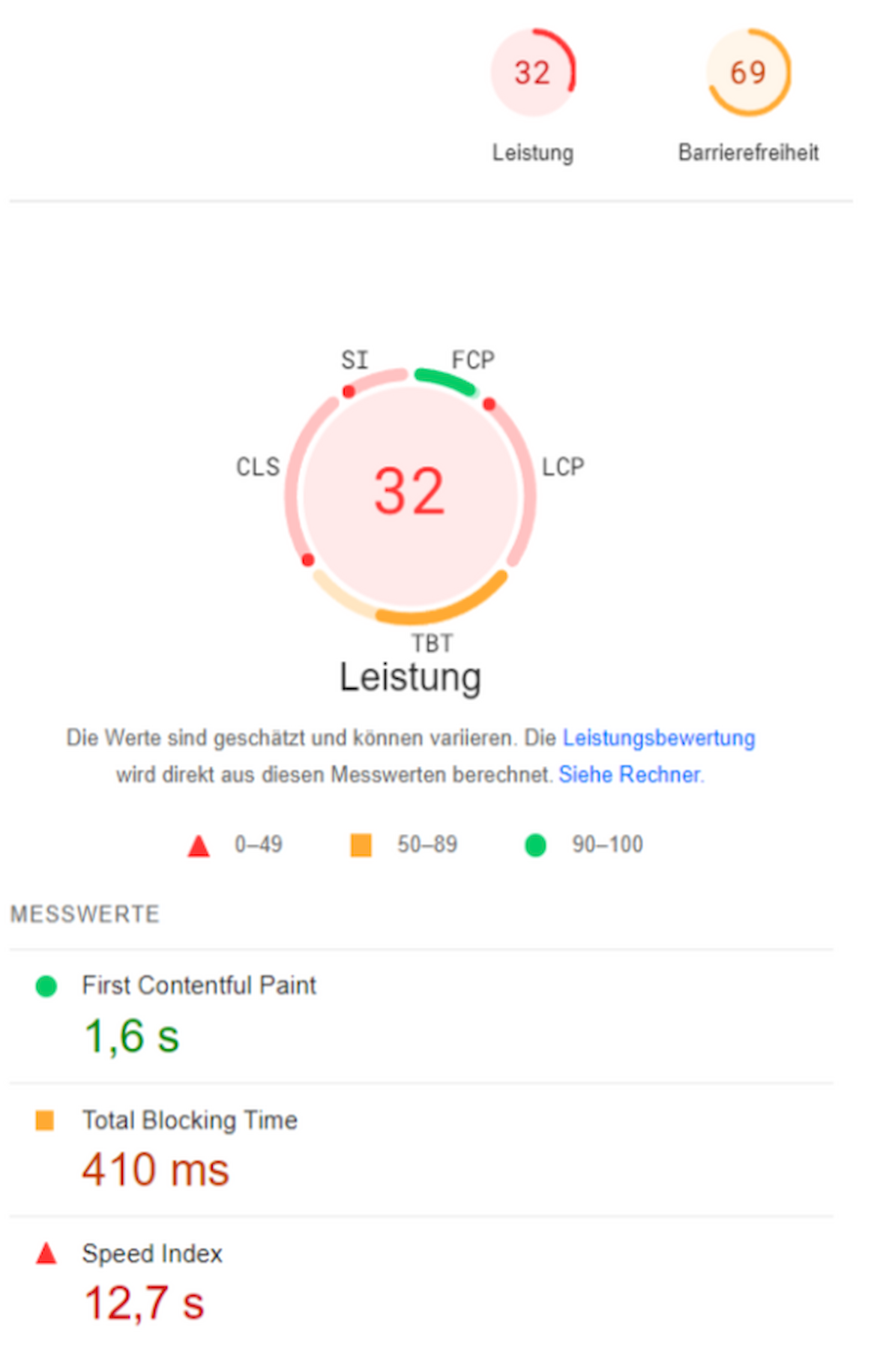
This includes a fast page load time. A Google study found that the bounce rate of a website increases by 106% if the page load time changes from 1 to 6 seconds. Who wants to waste their precious time waiting that long?
Slow-loading pages are often caused by large images that aren't optimized for the web and unnecessary data.
Here you can test your website’s speed.
Example: Slow page loading speed
...and lack of accessibility
2. lack of accessibility
Accessibility is also part of the usability category. Starting June 28, 2025, all websites must be accessible, meaning they must be usable by everyone without the need for additional assistive technology. But even before then, it makes sense to have an accessible website, because they are generally easier to use (Check it out now).
If there are restrictions on seeing, hearing, moving or processing information on the page, you will miss out on potential conversions by those affected.
Subtitles for videos or descriptions of images are therefore already a must-have today.
3. complicated page structure and lack of navigation
Is it easier to find your way through the jungle than on your hotel website? Too many sub-pages that are not clearly described, a lack of navigation and/or a vague allocation of sub-directories in menu items lead to the user being overwhelmed and not finding what they are looking for. Then they will quickly leave before they have even seen your packages.
4. wrong target group approach & missing USPs
You have a health hotel for older people seeking peace and quiet, but your website is as colorful as a party hotel in Ibiza with the corresponding language? Then it could be difficult to generate bookings. Incorrect targeting is not only a conversion killer, but also gives your hotel the wrong image.
If your corporate identity isn't clear and there are no visibly placed Unique Selling Points (USP) on your hotel website, your visitors won't even know what makes your hotel so unique. So maybe it's better to book somewhere else?
Your agency will give you a coherent corporate design & identity for your hotel.
5. lack of multilingualism
Do you want to make guests from all over the world happy? Then it would be unfavorable if your hotel website is only available in German. If visitors realize that they first have to translate the site (in the best case) via their browser, many will leave again. It should at least be in English. Hreflang attributes are used for automatic language recognition. Your agency knows what to do here ;)
6. complicated booking process
Great, your visitor wants to become your guest. What else could go wrong? Quite a lot! It can start with the fact that they can't find the book button on the page they are currently on. If they have to click through the pages, you've already lost them, because every additional click after the booking intention has arisen is a conversion killer.
And even if it is in the booking engine: If the whole procedure is too complicated or opaque (e.g. due to too many queries, it can lead to those famous shopping cart abandonments. Therefore: Keep it simple!
By the way, exit intent popups are an efficient and quickly integrated solution to reduce shopping cart abandonment by up to 30%. To find out what effect a website change has, we recommend that you carry out an A/B test.
7. the conversion killer par excellence: no mobile optimization
Mobile first! Even though Germans still like to stick to their desktops, 44.4% now go online almost exclusively via mobile (StatCounter, 2024). Globally, the smartphone is clearly in the lead with 58.99% and in Germany over 93% of 20 to 29-year-olds use it.
Mobile-optimized means, among other things:
- responsive design
- Fast loading speed (see point 1)
- larger buttons
- short checkouts (see point 6)
- and much more
If your site is not mobile-optimized, the user experience leaves a lot to be desired and the visitor will quickly leave.
8. lack of confidence building
A 2020 Bitkom survey found that 69% of hotel bookings were only made after guests had read through reviews.
Does your hotel already have enough reviews on Google, TripAdvisor & Co. Then you should also integrate these visibly on your website, along with your other references, awards and certificates. Because in times of scams and fake sites, it is essential to take confidence-building measures so that people get a good image of your hotel.
9. price on website more expensive than on Booking & Co.
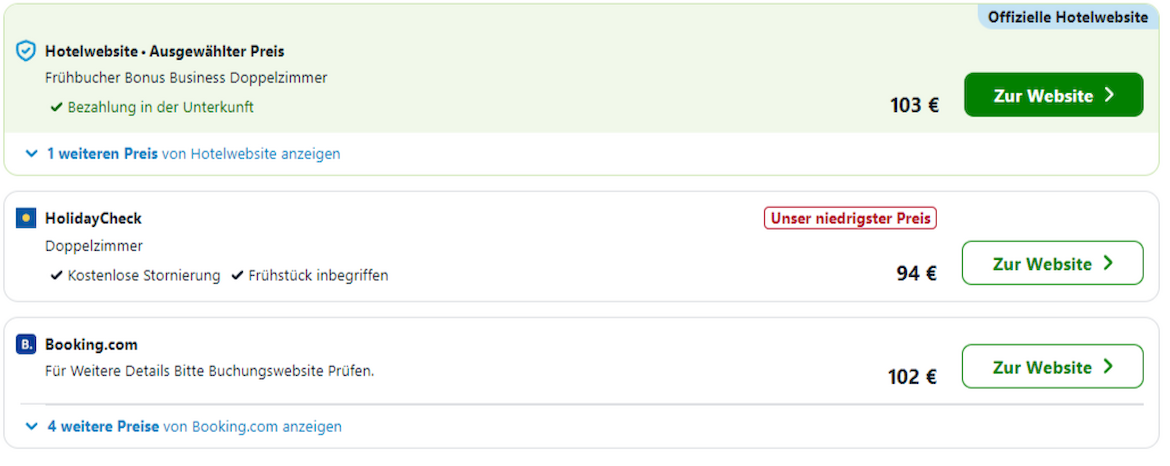
Trust is good, but verification is better: According to a 2023 Expedia study, 61% of respondents visit OTAs BEFORE booking on a hotel website. It’s a bummer if the prices there are lower than on your site, because then those expensive commissions are practically guaranteed. Because let’s be honest, would you pay more for the same thing just out of loyalty and pure altruism?
Do you already offer the best price around? Then it helps if your hotel is listed on
metasearchchannels to attract users directly to your website from Google, TripAdvisor, etc.
10. poor findability in search engines
Those who seek will find—but only under certain conditions will they find your website. Even the most beautiful landing page with the best offers is useless if no one ever sees it. If it isn’t optimized for search engines with correctly entered metadata and well-researched keywords, the page will gather dust at the very bottom of Google’s search results.
You can find more about search engine optimization
here.

11. lack of tracking
You can only find out how your hotel website is received by visitors if you track them. Where do they come from? How long do they stay on the site? Which pages are well received and bring in bookings? If this information is missing, you don't know whether and where you should optimize your site to make it rain bookings.
Ask your web agency for advice on this.
12. and last but not least: do not develop any new strategies
If bookings are down, sitting back and doing nothing is the worst strategy. Only by regularly analyzing your data and developing new strategies can you improve your performance or booking situation. Maybe you could try out new landing pages or run
search engine ads or send out
newsletters? There are plenty of options in online marketing!
Do you need help with conversion optimization? Then feel free to reach out to us. As a
hotel marketing agency , we’re familiar with the typical pitfalls we’ve encountered in many hotel projects.
Photos:
AILA_IMAGES, Fred jonson, ferrantraite
Latest Articles